Holding the Coats
Mornings at home have a typical routine. I’ve neatly stacked a series of habits that let me wake up slowly and sort myself out before the day gets loud. Coffee first. Feed the cats. Rotate the laundry while I practice Spanish. Meditate, read and journal. The predictability is comforting; the small, ordinary tasks remind me to slow down and stay present.
Wednesday morning’s routine didn’t look different than Tuesday’s. The same habits, stacked in the same order. And yet…the meditation that morning was about holding space, making room for feelings without trying to fix or move past them, and I got surprised by how much emotion it released. I finished up and opened my books app to the devotional reading for the day, and in one of those strange twists of fate, the universe seemed to line up.
Carry each other’s burdens, and in this way you will fulfill the law of Christ.
Galatians 6:2
How in the world was I supposed to carry someone’s burdens without trying to fix their hurt? All my life, I’ve been a solver—someone you can trust to help you find a way forward. I have always assumed that when people shared their problems, it was because they wanted me to do something.
That instinct served me well in a lot of spaces. It’s how I practiced medicine, often how I show up for family and friends, how I make sense of hard situations: see the problem → work on a solution → help move things in a better direction.
Life is complex, and it turns out not every problem can be solved. Maybe not every problem should be. And sometimes, narrowing your focus on finding the answer means you miss what is most important in the moment.
Here’s the pivot you didn’t see coming…
I don’t like riding roller coasters; I learned this fairly early in life. As a kid, even though I didn’t enjoy them, I still had a little FOMO watching everyone else line up, laughing and screaming and coming off the ride full of adrenaline. I rode a few roller coasters as a young adult when my good sense didn’t prevail. Every time, I spent the next several hours dizzy and nauseated, wondering how I could forget the way they made me feel. Thankfully, I eventually wised up.
Now, I’m the one who stays on the ground. I hold the coats and the bags and enjoy watching others ride. I’m happy to be the friend (or mom) who can manage all the “stuff” and be there when people get off, ready to move on to the next adventure.
Lately, I’ve been thinking about that more in the context of how I show up for people. When someone is on an emotional roller coaster, I have a choice. I can climb on with them—feel every rise and drop, every twist and turn—or I can stay on the ground. I can be steady and manage the mundane.
Staying on the ground doesn’t mean I don’t care. It doesn’t mean I’m not paying attention. It means I’m not adding my own dizzy and nauseated reaction to what’s already hard. It also means I’m ready to hand back the coats and help move on to life’s next adventure when the roller coast ride ends.
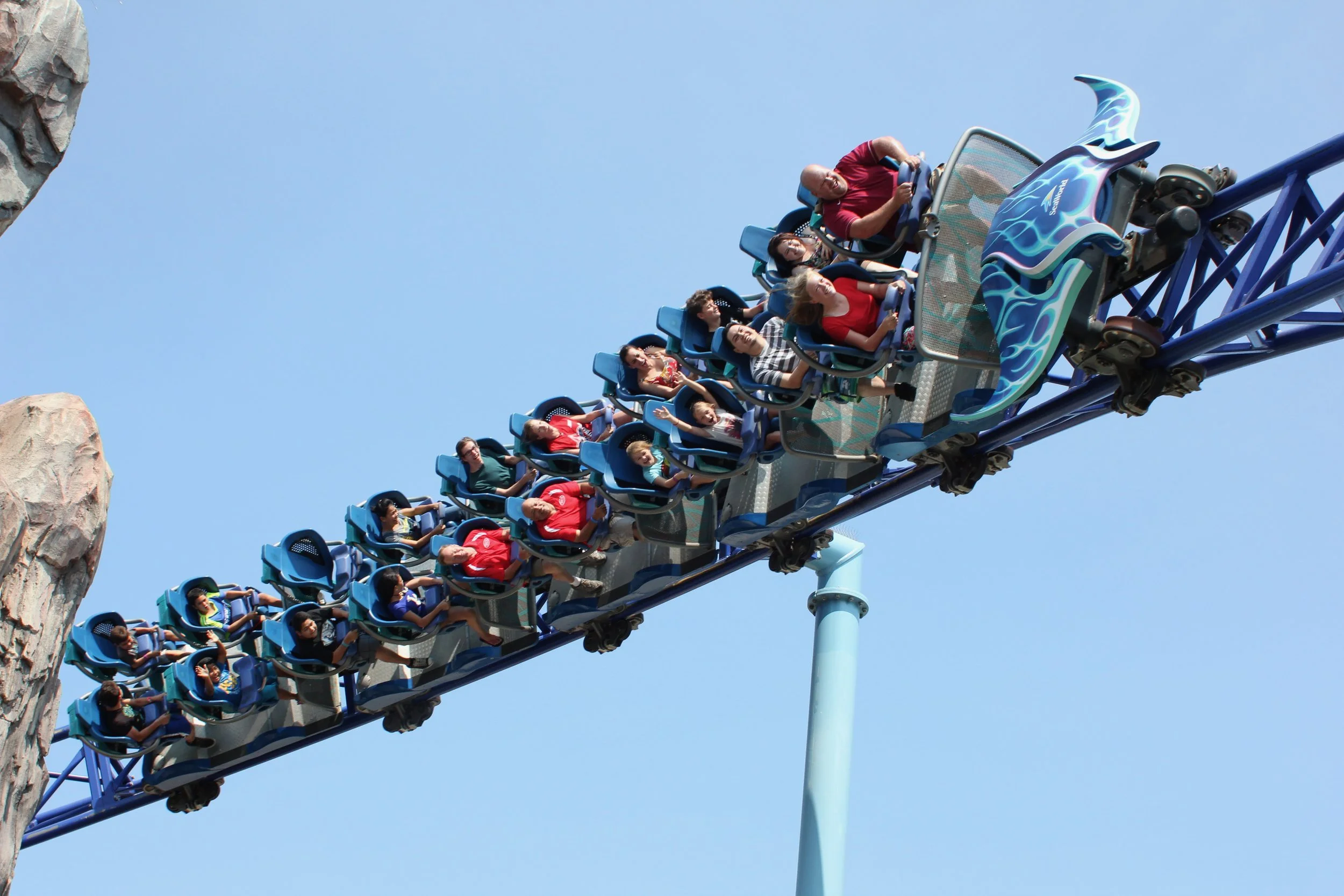
One of my kids on a roller coaster, 2014. (I’m on the ground with the coats.)